February 17, 2025
By Kim Lindquist, Director of Community Planning, WSB

Cities undertake various essential tasks to maintain their communities, one of which is code enforcement. This article explores the importance of code enforcement, the roles involved, and the advantages of outsourcing these efforts to ensure neighborhoods remain well-maintained and compliant with city regulations.

What is Code Enforcement?

Code enforcement is the process communities use to gain compliance with various city code violations within a community. Generally, cities always initiate code enforcement actions on a “complaint basis,” meaning that a neighbor or resident noticed something on a property that does not seem to meet the rules and regulations of the city. Many cities also conduct proactive code enforcement, where staff identifies violations, rather than the public, and acts accordingly. Complaints are typically issues that can be visually verified and include things like outside storage, junked or unlicensed vehicles, and parking on the grass. Throughout the summer, tall grass and noxious weeds are some of the most common complaints. Regardless of which methodology cities undertake, the goal is to maintain the value, character, and aesthetics of individual neighborhoods and the community.

Who Enforces City Code?

Cities may use on-staff personnel, such as a planner, Community Service Officer, or building inspector, for some code enforcement activities. However, as their workload has grown, more communities are exploring full-time code enforcement officers for the busy spring and summer months. Because this is a specialized role, and in certain climates workload is uneven, cities often look to fill seasonal code enforcement positions during the summer. In the current labor market, filling these positions has become more challenging. Outsourcing code enforcement can help cities provide the service without adding to existing staff workload and prevents them from hiring for a position that may be underutilized in the winter months.

Outsourcing Code Enforcement

WSB has had the opportunity to conduct code enforcement activities for various communities. In 2024 our team of skilled planners supported the City of Shoreview, among others. Shoreview is a community that conducts code enforcement mainly on a complaint basis but also has some proactive enforcement by choosing a neighborhood each year to canvass. By staffing their code enforcement work with a WSB Community Planner, they now have an extension of their staff who understand City Codes, particularly Zoning regulations which are often the more complex enforcement actions. As with most communities, Shoreview works to bring a property into compliance with education; explaining property maintenance rules is a key part of any code enforcement program. Our staff work with property owners to assist in bringing sites into compliance and more importantly, understanding what is and isn’t allowed by code.

There are many benefits to outsourcing code enforcement efforts. These efforts are often scalable, allowing our staff to ramp up during busier times and provide less service during slower times. WSB provides staffing flexibility to meet community needs. Smaller communities may need less code enforcement, and we have worked with smaller cities to provide less hours to meet their budget needs while efficiently implementing code compliance. Outsourcing code enforcement allows city staff more time to focus on other priorities, especially in a time of high development demands. WSB is one of few consulting firms that conduct code enforcement work for our clients, and our scalable model addresses many potential needs and resources.

Kim is a planning professional with over 30 years of experience overseeing a variety of complex planning projects. Kim worked in high growth communities working with developers and the public on entitlements for residential development and business attraction to the city.

[email protected] | 763.287.8303

By Steve Lindsey, Director of Transportation, WSB

In 2021, Texas added more people to its population than any other state. For residents, businesses, and communities, it’s critical for planners to meet the immediate needs of citizens, while also planning for the future. For local, city, and county governments, corridor studies play a key role in creating and executing comprehensive transportation design that adapts to and meets the needs of growing communities.

What is a Corridor Study?

Corridor studies examine the relationship between roadways and adjacent land. In more densely populated areas, this can mean figuring out ways to overcome challenges where roadway expansion is limited. For land in development, it means looking at future population growth and where investments are being made to build homes, businesses, and public services.  Corridor studies also help ensure that if opportunities to acquire land becomes available – whether because they are being sold or planned for future development – there is a long-term view on how to best meet transportation needs.

Corridor studies are instrumental to help communities plan for 5, 10, and even 50 years down the road.

Trends in Community Growth

In Central Texas, Austin and the surrounding communities are growing rapidly. It is a technology hub with major companies like Tesla, Apple, Dell, and Samsung employing thousands of people. Densley urbanized areas have seen population growth, and more people are building homes and businesses in communities farther and farther from the city centers as the population grows.

Additionally, with the ongoing pandemic, we’ve seen more people looking to build homes, expand their space, and work remotely. With a hot housing market and population growth, more people are building and expanding into areas that were traditionally more rural or predominantly farmland.

Communities need properly planned transportation infrastructure to help transport people and commerce in those growing areas.

Working with the Experts

For community leaders facing growth challenges and working to plan for what’s next, it can be difficult to know when and where to start. When we partner with clients, we help them explore what opportunities their community can tap into in transportation design, and corridor studies are an important tool to get them and their community where they want to go.

Steve brings over 22 years of experience in all phases of the transportation industry including schematic, environmental, GEC/program management, construction and plans, specification and estimates (PS&E). He has a history working with TxDOT divisions and districts around the state as well as municipal clients in central Texas.

[email protected] | 512.983.5624

By Kim Lindquist, Director of Community Planning & Economic Development, WSB

Cities have spent the last few years working feverishly to get their comprehensive plans completed and approved. Many communities are now breathing a sigh of relief, recognizing the heavy lifting is complete. Unfortunately, for some the work has just begun as cities and townships enter the implementation phase of the updating process.

Most communities are good at keeping up with zoning issues that often arise, such as short-term rentals or solar farms. Zoning text amendments come up due to necessity as land use and issues dealing with structures change over time. Communities are often confronted with something unforeseen when drafting their ordinance and therefore need to amend to stay current.

Unfortunately, ordinance amendments modifying regulations may occur frequently, but there seems to be less time for critically evaluating the ordinance in its entirety. While it is common for regulations to be added to an ordinance, obsolete or confusing items are rarely removed. As residents are increasingly looking to city websites for information, cities should consider if their ordinances have been reviewed for readability and clarity for the “non-planner” public.

WSB’s Community Planning and Economic Development Group has recently been working with communities to review their ordinances. In addition to reviewing them for regulations and legal consistency, we are evaluating their presentation and readability. We are helping these communities to improve the way that the information is presented to ensure that clients, staff and the public can quickly find the answers they are looking for regarding planning and zoning with minimal frustration.

For example, residents may need to look in multiple locations within an ordinance to find the information necessary for completing a simple accessory structure building permit. Setbacks, size, exterior materials, and location standards are often placed within different sections of the zoning code, making it difficult for residents to locate. This building permit “maze” often leads to frustrated residents and calls to the community staff, many of which can be avoided through more concise and clear ordinances.

Additionally, as new staff come on board, the knowledge regarding the original intent of the ordinance may be lost. Improving clarity of the ordinance benefits both residents and practitioners, resulting in more efficient use of community resources.

Kim is a planning professional with over 30 years of experience overseeing a variety of complex planning projects. Kim worked in high growth communities working with developers and the public on entitlements for residential development and business attraction to the city.

[email protected] | 763.287.8303

By Bart Fischer, Sr. Public Administrator, WSB

As organizations evolve and change over time, it is important for leadership to reflect on the past, evaluate the present, and prepare for the future. This can be done through a regular strategic planning process. The following are five important reasons to conduct a routine strategic planning process.

Set a Clear Direction & Priorities

As organizations change over time, it is essential that leadership, stakeholders, and new staff joining the organization understand where the organization is headed and how it is getting there.  This direction and priorities will serve as a road map for future success.

Build Trust & Relationships

For the prolonged success of any organization, there needs to be trusting relationships.  Bringing leadership and stakeholders together regularly to truly listen and understand one another, helps lead an organization to consensus on their vision, mission, and priorities for the future.  Consensus does not always mean 100% agreement; however, it means a spirit of understanding and collaboration around the culture and direction of the organization.  This process allows for teams to be on the same page and drives alignment.

Set Agendas & Simplify Decision-Making

Refocusing on the long-term view can be beneficial as short-term gains often slow long-term growth.  Having a strategic plan means that despite hardships, the focus is on the end goal and not changing course to avoid short-term hurdles.

Focus & Budget Limited Resources

A strategic plan helps focus limited resources such as staff, time, and money.  It prioritizes where the organization can be most effective in creating a sustainable community for the future.

Communicate the Message

With a strategic plan, each leader has a consistent message and is better able to communicate that message across stakeholder groups.  Everyone is “singing the same tune.”  Those in charge of individual parts of an organization, know roughly the direction other departments are heading without needing to know the details of how they are accomplishing it.

Bart Fischer has over two decades of experience in public administration. Throughout his tenure, he’s worked in five Minnesota communities as the city or assistant city administrator.  Bart joined our firm in 2019 as a senior public administrator and focuses on lending his public service expertise to our clients.

[email protected] | 651.286.8484

Lindquist joins WSB after nearly 20 years with the city of Rosemount

Engineering and consulting firm WSB announced today that Kim Lindquist has joined the organization as their director of community planning and economic development. Lindquist joins the firm’s Golden Valley office where she will lead WSB’s community planning and economic development efforts and client activities.

Lindquist brings over 30 years of planning and economic development experience to the position. She has held positions in several communities throughout the Twin Cities metro including Rosemount, Cottage Grove, Minnetonka and Mounds View. 

“Kim is a well-known industry veteran whose experience and knowledge will be a benefit to our staff and clients,” said Monica Heil, vice president of municipal services at WSB. “Kim’s forward-thinking approach to land use planning and development, coupled with her sound understanding of zoning requirements will support WSB’s project delivery throughout many service areas.”

Most recently, Lindquist was the department director for the community development department at the city of Rosemount for over 17 years. Her role was responsible for the operations of the department, long-range planning, economic development, building permit inspections, Fire Marshal activities, code enforcement and GIS functions.

“I’ve always thrived in mission-driven organizations that support our communities,” said Lindquist. “I’ve had the opportunity to work with WSB several times throughout my career and I’m thrilled to join a team that is committed to actionable, realistic and unique solutions that achieve our client’s visions.”

WSB’s community planning and economic development services include comprehensive planning, zoning ordinance and development codes, economic development, capital improvement planning, small area plans, planning and zoning administration and code enforcement.

In the wake of the civil unrest following the death of George Floyd, the United States Postal Service (USPS) experienced significant damage to two post offices in south Minneapolis.

WSB’s Environmental Remediation and Structures team assisted USPS with their emergency response and environmental and structural needs. Our team worked to identify and analyze any potentially harmful materials that may have been released into the environment that could pose an immediate risk to emergency responders, the public or postal workers.

Riots and protests in the area brought many U.S. Marshalls, Secret Service agents and FBI investigators to the scene. Determining the structural and environmental safety of the buildings was paramount to USPS’s emergency response. The structures were deemed a total loss and the team identified many hazardous materials caused by the fire and destruction of the buildings. USPS is currently in the process of rebuilding one of their facilities and performing environmental clean-up at both sites. Our team will continue to partner with USPS on several other environmental clean-up projects throughout the Midwest.

Preparing for and planning staffing support and resources at the local level is crucial to ensuring that the needs of the community are met, and statutory timelines adhered to. Sometimes, internal team members do not have the capacity to handle all the workload. Busy seasons, staff turnover, leaves of absence and unexpected challenges or needs arise that can throw a wrench in original staff and workload plans. In these instances, a consulting partner can be helpful to maintaining a high level of service while staying within budget and resource constraints. Here are four reasons to consider professional consultants to help augment your staff’s capacity:

Scalable

Unlike a full-time staffer, a consultant can be there for you as much or as little as you need. This gives you the ability to scale the level of service depending on your busy times or when your staff are unavailable. A consulting team can quickly adapt to your workload.

Cost-effective

Consultants offer many different pricing structures that can range from stable monthly retainers to on-call hourly services. One of the strengths of a consulting partner is the range of expertise levels. Matching expertise with the level of skill needed allows for flexibility in budgets. In addition, an outside consultant can also present other options for partners or creative resources that weren’t initially considered.

Team approach 

A team approach means that you have access to the expertise and resources of an entire consulting firm when issues or challenges arise. When partnerships are formed between public and private entities, you are hiring a team and not just an individual. There is always someone with the necessary experience when a question needs an answer, a problem needs to be solved or an application needs to be completed.

Always available 

With a consultant comes a deep bench of expertise. When someone isn’t available, you can rest assured that there is always someone available to attend meetings, field questions and review information in the event of a vacation or illness.

People often associate consultants with unnecessary expenses, but there are many cost-effective and creative ways that a consultant can actually reduce costs and help stretch budgets.

Conclusion

At WSB, we pride ourselves on having a team of expert staff dedicated to keeping communities running smoothly. Many of our team members have served in the public sector as City Engineers, Planners, Transportation Engineers, Directors of Public Works, among other public sector roles. Therefore, we know firsthand the challenges and opportunities local leaders experience. By leveraging our comprehensive expertise and deep understanding of the public sector, WSB stands ready to support your community’s needs efficiently and effectively.

Following comprehensive plan development, communities in the 7-County Metro are expected to update their zoning ordinance.

By Molly Just, Senior Planner, WSB

Zoning is an important tool to promote and manage growth and to help residents and businesses manage expectations about what they, and their neighbors, can do with their property. Without updating the zoning ordinance many planning goals may not be attainable. Read this article for more reasons about why updating your zoning ordinance is essential.

Ensure your zoning regulations are up-to-date by following these simple steps.

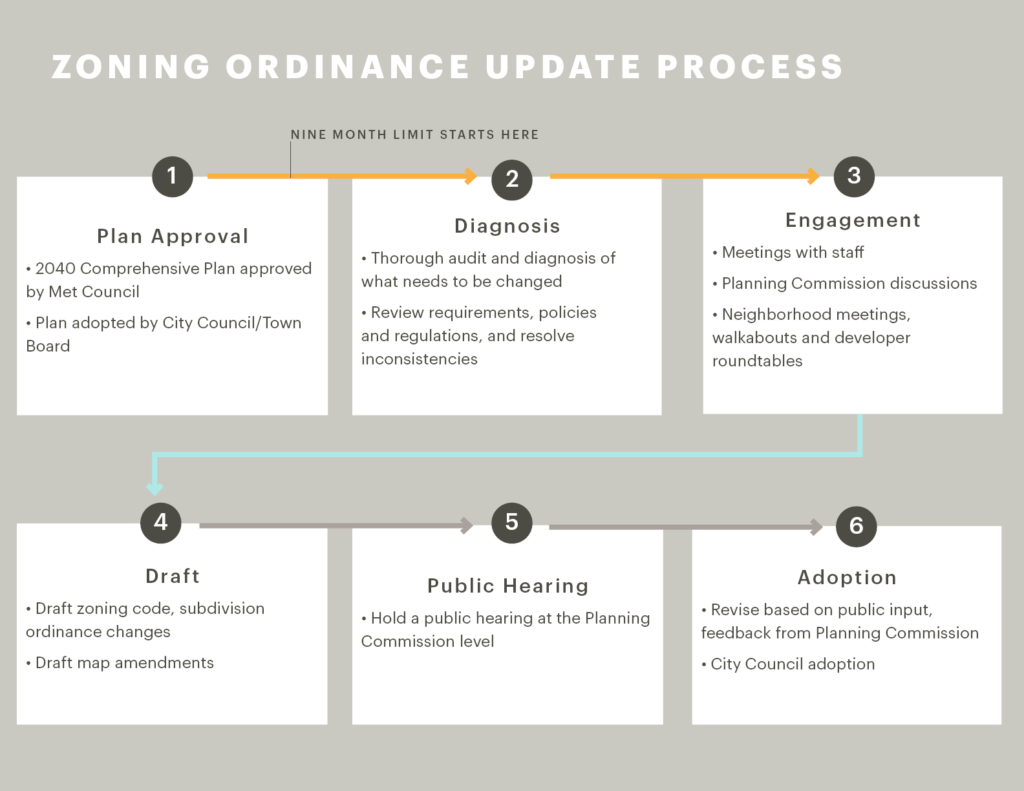
9-month clock starts. State statute and the Metropolitan Council require that “official controls” be updated within nine months of Comprehensive Plan Adoption. This includes zoning text, zoning map and subdivision ordinance.

  1. Plan approval – Your 2040 Comprehensive Plan is approved by the Metropolitan Council and adopted by the City Council or Town Board.
  2. Diagnosis – The process of updating the ordinance should begin with a thorough audit and diagnosis of what needs to be changed. Potential things to look for include: changes to existing district densities and lot requirements to conform with Comprehensive Plan densities; zoning map changes to conform with the Future Land Use Plan; text changes based on Plan goals; incentives consistent with housing and economic development policies; updates to outdated regulations; resolving inconsistencies; updates to minimize non-conformities.
  3. Engagement – Hold meetings to identity issues and potential map changes. Re-engage comprehensive plan stakeholders as allies in support of implementation.
  4. Draft – Be sure to draft any zoning code and subdivision ordinance changes, and map amendments that apply.
  5. Public hearing – Once your zoning update plan is drafted, hold a public hearing for the Planning Commission to discuss further.
  6. Adoption – Revise your draft per the feedback received from the Planning Commission and submit to the City Council for plan adoption.

Communities should also plan to implement and educate during the planning process to ensure a successful outcome.

Plan to implement. Keep track of zoning items during the comprehensive plan update process and in the final year of planning, incorporate an implementation line item into next year’s budget. It takes zoning to implement many of the land use and housing goals set forth in the comprehensive plan.

Plan to educate. What is zoning? What can and cannot be achieved through zoning? Plan to keep a list of policy issues that need to be addressed separately, such as property maintenance.

Learn more about how WSB can assist your city with comprehensive planning and zoning services.

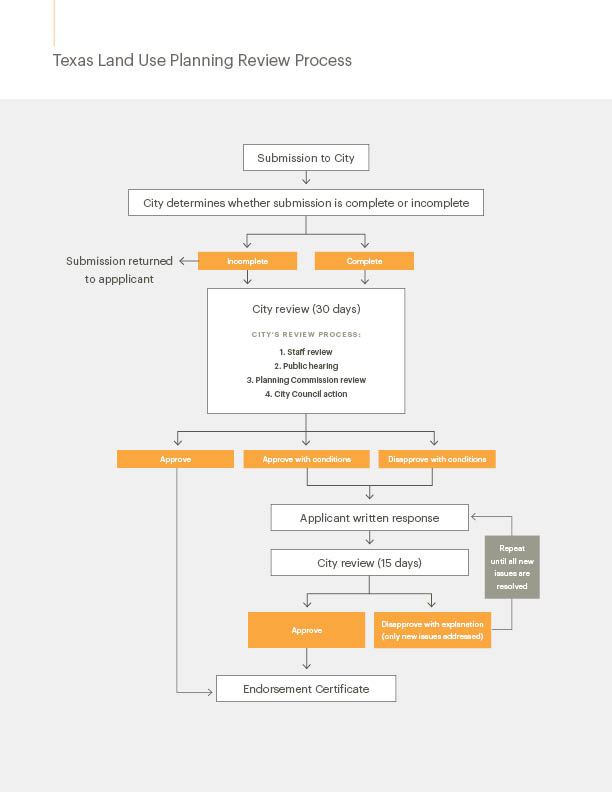
As of September 1, Texas has made several changes to the land use planning review process. Specifically, the site plan and subdivision platting approval processes have been shortened to 30 days. The chart to the right demonstrates the revised work flow and timelines used in order to compile with the new planning review process. This new schedule is increasing pressure on local municipalities who are likely feeling pressure to comply with the new application process.

Our community planning team is experienced with navigating legislative and ordinance process changes that create tight deadlines. We have spent years leading clients through city internal reviews and staff capacity issues. By assisting with ordinance and procedural changes, tracking applications, handling communications, and ensuring that all statutory requirements are met, we help our clients meet the needs of their communities. Our team uses an interactive and quality control approach to account for every detail to ensure our clients’ success and the smooth operation of their Planning Department.

Client communities can relax and feel confident that their boards, councils and commissions have all the information they need to make educated decisions during the changing legislative landscape and the entire planning review process.

Learn more about how we can help, contact us.

Molly Just, Sr Planner, WSB

So, your comprehensive plan is done – and everyone is breathing a big sigh of relief. Now what?

A community’s comprehensive plan includes recommendations on land use, housing, and other areas that are described and enforced by that city’s zoning ordinance and subdivision ordinance. Without updating the zoning ordinance many planning goals may not be attainable. Zoning is important to promote and manage growth and to help residents and businesses manage expectations about what they and their neighbors can do with their property. Simply put, you can’t attain the development goals established in a comprehensive plan without a zoning ordinance.

A sense of relief and accomplishment at the end of the comprehensive planning process is understandable; it can take years to update a comprehensive plan. As a former local government planner, I have been asked many times if a plan will just “sit on the shelf.” This often stems from a lack of ability to build the plan. Zoning means different things to different stakeholders. For developers, zoning is a building tool. For residents, it is a tool used for protection from the unknown. For local government, it is a tool to promote the prosperity, health, and welfare of the whole community. For planners, zoning is a tool to achieve the plan goals. Turning a comprehensive plan into a reality can be largely based on the zoning ordinance. An update to the zoning ordinance should be incorporated when updating a comprehensive plan.  

Here are four reasons to update your zoning ordinance:

  • An update leads to increased buy-in from elected officials and community stakeholders.  Planning is a visionary process. If stakeholders know that the zoning comes next, they may be more likely to participate and stay involved. The zoning ordinance puts plans into action.    
  • It helps ensure the zoning work will be completed and budgeted for in advance of planning fatigue that can overwhelm the late phases of updating the comprehensive plan. 
  • The comprehensive plan visioning may be stronger with the knowledge that zoning should occur immediately following completion. The comp plan will be more targeted to the conditions of the community and supported by stakeholders and elected officials. In other words, visions are rightsized to the community.
  • The plan visions may be sooner realized. Oftentimes planning fatigue and competition for staff time and resources result in zoning updates being pushed off for months or years, potentially resulting in legal challenges or extended project timelines.

And beyond just planning for the zoning update, here are six reasons to update your zoning ordinance:

  • Legal protection.  Zoning decisions that have no basis in the comprehensive plan are more successfully challenged in court.  There must be a rational basis for zoning decisions and requirements.  Additionally, cities in the Twin Cities metropolitan area must comply with the Metropolitan Land Planning Act which imposes certain mandatory zoning and regulatory requirements and requires that zoning directives harmonize with and not contradict the comprehensive plan. 
  • To reflect federal and state law pertaining to land use and zoning.  For example, how we regulate non-conformities has changed in Minnesota, with local authority over non-conformities weakening.  Also, legal decisions regarding signage impact how local government reviews sign applications.
  • To incorporate plain language and resolve internal conflicts that are the result of decades of incremental updates.  The use of plain and clear language to define uses and terms strengthens the legal standing of ordinance interpretations. 
  • To address confusing concepts that have led to inconsistent application of code.  Modern zoning codes use graphics to illustrate concepts such as setbacks, lot coverage, and floor area ratio.
  • To adapt to societal changes that conflict with narrow use categories and single-use zoning, such as allowing home offices, businesses, accessory units, and accessory structures within homes and on single-family lots.
  • To incorporate best practices in land use and development that focus on how a building fits into its context and ways to mitigate use conflicts rather than narrowly legislate use of private property.

Although, there are many factors that determine how quickly a comprehensive plan can become a reality, zoning is certainly not a factor to discard. 

WSB Staff working in the lobby of the WSB headquarters.

Discover Our Difference

We partner with our clients and communities to build what’s next in infrastructure – the places, spaces, and systems that support our lives.