2021 has presented a number of challenges to communities, not least of which was a major drought. Minnesota was faced with above-normal temperatures along with lower-than-average precipitation, resulting in one of the worst droughts seen in the area in the last 20-30 years.
As we move into fall and winter in Minnesota, leaders may be thinking that the worst of the drought is over and that they can move on to thinking about managing winter snow and cold. However, the ramifications of the drought are likely to continue into 2022. Below is a list of some of the ways the drought may have longer-term effects to communities.
Loss of saplings. Communities that implemented projects in 2021 that included planting saplings are likely going to find that many of them have not survived the year and are going to need to be replaced in the spring.
Mature tree loss. Due to the stress of drought, mature trees in the community may have suffered from pests or disease. These shade trees are a major resource to communities and may need to be treated or replaced.
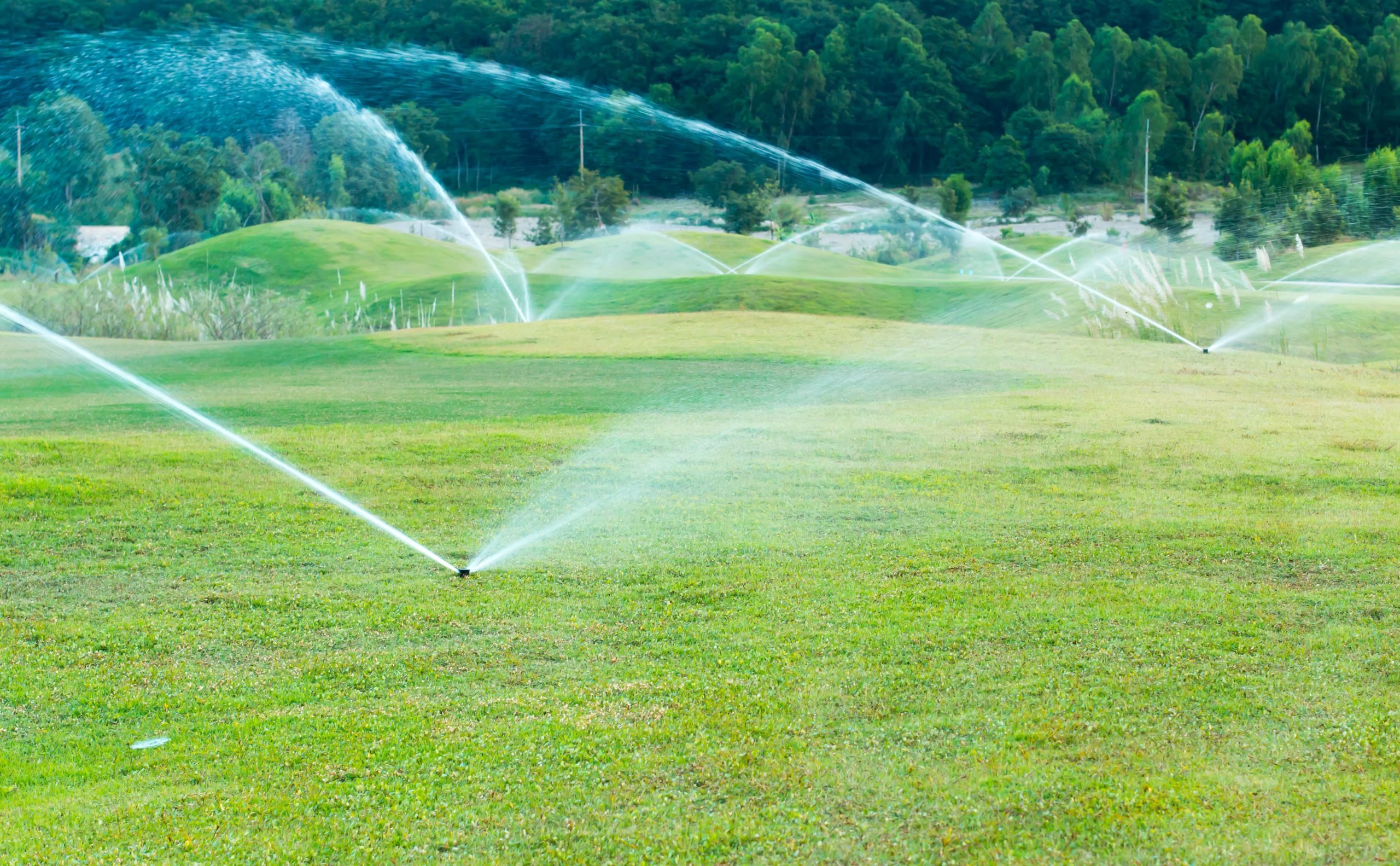
Watering restrictions. Many communities implemented watering restrictions due to drought conditions. Irrigation systems that ran too often or for too long used more resources than necessary leading to reduced water availability for daily needs. This also resulted in concerned or confused residents that didn’t understand how or why these restrictions were needed for the good of the community.
Low reserves of community water supplies. In addition to increased watering demands for vegetation, valuable water was often lost through inefficient or defective equipment in many residents and businesses.
Well interference. Drought can often result in domestic or municipal wells running out of water. The MN DNR received significantly more calls this year than normal about dry wells that require them to investigate and often result in owners or municipalities incur repair costs.
Nearly all Minnesota cities experienced some or all these challenges this summer. As a result of the extreme stress put on local water infrastructure, the MN DNR has put together the 2021 Drought Assistance Proposal. This proposal includes a request for $13.3 million in funding to help cities address the effects of this drought.
WSB is tracking the funding package as it moves through the legislature and will be prepared to assist clients with grant applications for the fund as well as identify other funding opportunities that are tied to this effort.
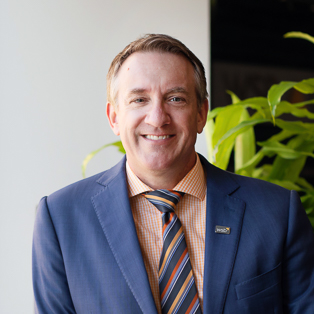
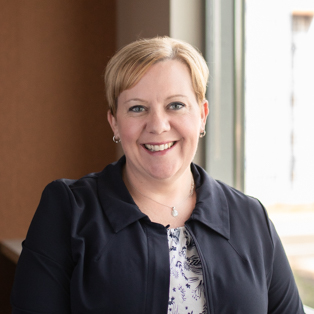
Alyson is a Senior Project Manager in WSB’s Municipal Group and the City Engineer for the City of Minnetrista. With 20 years of engineering experience in the municipal industry, Alyson Fauske has built her career providing municipal engineering services throughout the Twin Cities.
Bart Fischer, Senior Public Administrator, WSB and Gary Carlson, Intergovernmental Relations Director at the League of Minnesota Cities (LMC) unpack the issues communities should pay attention to post-legislative session.
This year, there was an interesting confluence of state and congressional legislation that will impact cities more than any other time in history. The pandemic and recovery efforts will have a tremendous impact of congressional action on our cities and understanding and navigating these impacts can be extremely important in the coming months.
BF: It seems like it wasn’t that long ago that we were talking about the top issues to pay attention to going into this session, Gary. Thanks for taking the time to dive into the takeaways with me post-session.
GC: Anytime Bart. It was an exciting session with a lot of moving parts. I think one of the biggest takeaways was the impact to our state budget and the American Recovery Act. There are still many question marks and unknowns about the federal package, but if you go back a year ago, we were facing a $2.4 billion deficit and we’ve ended up with quite a surplus due to a recovering economy and the federal government. At the beginning of the session, cities and counties were watching closely as the pandemic impacted tax collections and how it would affect local government aid (LGA) distributions and road funding. Relief packages have bolstered our economy and made the economic recession much less impactful. We were expecting to see deep cuts in state aid, but the legislature put over $5 million into LGA to preserve funding for all cities.
In addition to increased funding for communities, we were also looking for some flexibility in the use of TIF to account for the impact of the pandemic. TIF districts that were created between January 1, 2018, and June 30, 2020, now have three more years to complete development activities.
BF: It’s great to hear some positive news after a year of so many challenges. The pandemic has certainly had significant impacts on our communities. Anything outside of the pandemic or relief packages that communities should be paying attention to?
GC: Yes – the Local Option Sales Tax. For many years, we’ve been having conversations about authorizing local sales taxes without the need for legislative approval. In recent years, the legislature has been trying to define what these sales taxes can be used for. This session, they have further defined allowable uses to be capital projects of regional significance that are generally buildings, park improvements or trails that provide benefits to both residents and non-residents. For example, civic centers, libraries, regional parks and trails, etc. This year, almost every county or city that sought approval for a Local Sales Tax option were approved at least in some part, with the notable exception of proposals for roads and water/wastewater projects. I expect that the trend towards sales tax as a local funding source will continue.
BF: That’s great news. Anything else related to taxes?
GC: We’ve been seeking streamlined sales tax exemption for local government construction projects for many years. This year, the sales tax refund process was extended to include public safety facilities when a city or county uses a construction contractor to make the initial purchase of materials. We’re really happy to see this happen. This has the potential to reduce costs by nearly 7%. Contractors will basically provide documentation of the sales tax paid on construction materials and the city can file to get a refund of that money. This is a huge benefit especially if you think about the rising cost of building materials.
BF: Speaking of public safety, I heard that communities are now able to create multi-jurisdictional fire departments. Can you speak to that?
GC: Yes, this is an issue that many communities have been fighting for years. A group of cities or towns can now form a fire protection district and use economy of scale to fund fire protection more thoroughly. This option allows many cities to be more efficient and it’s a good government reform effort as well. I think you’ll start to see a lot of cities and townships start to explore this option as many around the state are struggling to find enough volunteer fire fighters to staff their stations.
BF: Any final thoughts on this session?
GC: I think the biggest challenges cities and counties have in front of them is determining how to use the federal funds from the American Recovery Act. So far, 21 cities have received their distributions directly and there are 800+ more still waiting. Determining how to spend the funds will be a long-term project for many communities. Right now, cities can use the funds for a number of things; however, in relation to infrastructure, it is limited to water, sewer and broadband projects. There is some talk that Congress will allow the money to be used more broadly for infrastructure related projects. Communities of all sizes have different needs and adding some additional flexibility will really help with other infrastructure needs.
BF: Thank you, Gary. As always, I appreciate your expertise and valuable information.
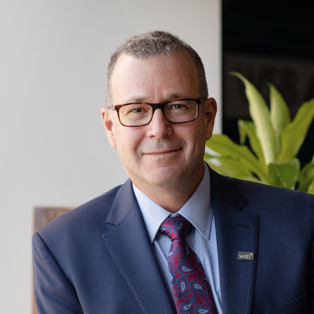
Bart Fischer has over two decades of experience in public administration. Throughout his tenure, he’s worked in five Minnesota communities as the city or assistant city administrator. Bart joined our firm in 2019 as a senior public administrator and focuses on lending his public service expertise to our clients.
Gary Carlson
Gary Carlson has 37 years of experience in government affairs. As the Intergovernmental Relations Director at the League of Minnesota Cities, Gary leads the League’s legislative efforts that matter to cities including aid to cities, economic development, employment and human resources, pensions and retirement, public finance, taxes, tax increment financing (TIF) and workers’ compensation.
As of May this year, many states are experiencing abnormally dry conditions with some regions in drought. These drought conditions significantly impact municipal water supplies which leads to water restrictions.
The type of water that cities supply to their residents is treated for a number of economic and environmental reasons. Cities measure the annual average demand and peak demand, but drought conditions like we’re experiencing now, fall outside of annual averages.
During drought conditions many cities implement additional water restrictions, and many residents don’t understand how these restrictions can help restore water levels within a matter of hours. Although it doesn’t seem like limiting irrigation or water use would have much of an impact, it significantly improves a city’s supply.
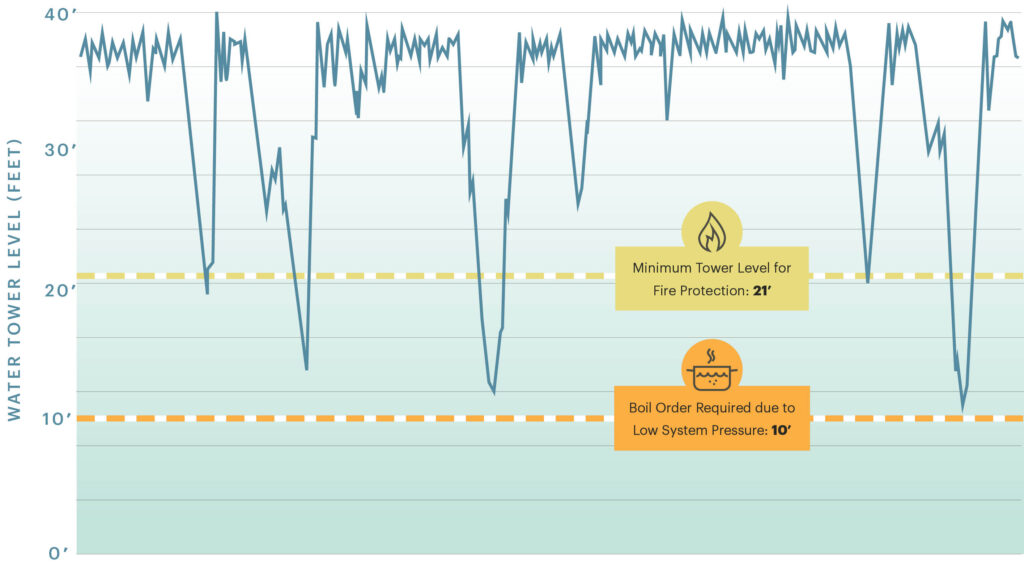
Enacting water restrictions alleviates the demand and can prevent communities from falling below fire protection and boil water levels. The diagram below shows an example of a water tower’s levels in a week. Water towers have censors that measure elevations. There is a minimum water level within the water tower to provide adequate fire protection. In our example, that level is 21 feet, meaning if there were a fire and the water tower level was below 21 feet there may not be adequate supply to fight the fire.
There is also a minimum level that needs to be maintained in the water tower to ensure that the pressure in the system is high enough to keep contaminants from entering the water system. In our example, if the water elevation drops below 10 feet a boil water notice would be implemented.
There are several actions that communities are taking today to help limit water usage including developing water reuse systems and plans, adjusting landscaping to include more native, drought resistant plantings and grasses, and reducing overall water consumption.
Instances of severe drought remind us that water is not a limitless resource and that forces outside of our control can have major impacts on our infrastructure.
With 20 years of engineering experience in the municipal industry, Alyson Fauske has built her career providing municipal engineering services throughout the Twin Cities. Her portfolio of work includes street and utility reconstruction, technical analysis and field observations, direct project planning and management, and comprehensive and capital planning services.
The award recognizes exceptional leadership in the AEC industry
Local engineering firm WSB today announced that Monica Heil, vice president of municipal services, was named by the Zweig Group as a 2020 Rising Star. The Zweig Group, the Architecture Engineering and Construction (AEC) industry’s leading research, publishing and advisory services resource, recognizes Rising Stars annually as part of their awards program. Rising Stars are professionals whose exceptional technical capability, leadership ability, effective teaching or research has benefited their employers, clients and community.
“Monica is a bold leader who believes in delivering projects with technical excellence and collaboration and I am so proud that she’s been recognized by our industry,” said Bret Weiss, WSB’s president and CEO. “She plays an important role on our leadership team and is known for her ability to attack projects and challenges head on. Her work on critical infrastructure projects throughout the Twin Cities is not only a benefit to WSB, but to the communities she works in.”
Heil is a civil engineer who has served Minnesota communities for over 15 years. She has a deep understanding of the long-term operations and maintenance needs associated with municipal engineering. She believes in developing long-term solutions that have had a profound effect on the communities she serves.
“I am honored to have been recognized by the Zweig Group, our industry and by WSB as a Rising Star,” said Heil. “It’s humbling when you hear that your efforts are appreciated and respected. The work we do as civil engineers is rewarding, and I’m looking forward to continuing to lead our clients and teams through their most critical and challenging infrastructure projects. “
The Zweig Group’s Rising Stars are selected by a committee of judges who represent civil and structural engineering. The Rising Star Awards were conferred at the Zweig Group’s virtual conference, ELEVATE AEC.
Preparing for and planning staffing support and resources at the local level is crucial to ensuring that the needs of the community are met, and statutory timelines adhered to. Sometimes, internal team members do not have the capacity to handle all the workload. Busy seasons, staff turnover, leaves of absence and unexpected challenges or needs arise that can throw a wrench in original staff and workload plans. In these instances, a consulting partner can be helpful to maintaining a high level of service while staying within budget and resource constraints. Here are four reasons to consider professional consultants to help augment your staff’s capacity:
Scalable
Unlike a full-time staffer, a consultant can be there for you as much or as little as you need. This gives you the ability to scale the level of service depending on your busy times or when your staff are unavailable. A consulting team can quickly adapt to your workload.
Cost-effective
Consultants offer many different pricing structures that can range from stable monthly retainers to on-call hourly services. One of the strengths of a consulting partner is the range of expertise levels. Matching expertise with the level of skill needed allows for flexibility in budgets. In addition, an outside consultant can also present other options for partners or creative resources that weren’t initially considered.
Team approach
A team approach means that you have access to the expertise and resources of an entire consulting firm when issues or challenges arise. When partnerships are formed between public and private entities, you are hiring a team and not just an individual. There is always someone with the necessary experience when a question needs an answer, a problem needs to be solved or an application needs to be completed.
Always available
With a consultant comes a deep bench of expertise. When someone isn’t available, you can rest assured that there is always someone available to attend meetings, field questions and review information in the event of a vacation or illness.
People often associate consultants with unnecessary expenses, but there are many cost-effective and creative ways that a consultant can actually reduce costs and help stretch budgets.
Conclusion
At WSB, we pride ourselves on having a team of expert staff dedicated to keeping communities running smoothly. Many of our team members have served in the public sector as City Engineers, Planners, Transportation Engineers, Directors of Public Works, among other public sector roles. Therefore, we know firsthand the challenges and opportunities local leaders experience. By leveraging our comprehensive expertise and deep understanding of the public sector, WSB stands ready to support your community’s needs efficiently and effectively.
Obviously, it can’t be understated how difficult and challenging 2020 has been for our communities. Challenges usually bring opportunities and it is all in how we, as public administrators, are able to weave strategies together with these challenges and opportunities. That is what we are faced with year after year, month after month and week after week. Opportunities to provide solutions to unique challenges.
Budgets are a local government’s blueprint to fund community amenities and programs that are necessary to maintain and improve safe, healthy and thriving communities. They are one of the most important ways public administrators can influence creative solutions to the unique challenges public organizations face. That is why the theme of this piece is budget focused.
The summer months are when the “meat” of the budget process happens. As the September 30th deadline for the adoption of a preliminary levy approaches, elected officials and public administrators work hard to proactively project future revenues, evaluate services provided, identify priorities and needs, and come up with creative solutions and opportunities for these priorities.
During this particular time, it is also important to think about how COVID will affect future revenue, continued service provision and operations. As I have spoken with public administration colleagues, there seems to be a cautious optimism. Yes, there will likely be delinquent property tax payments as well as lower revenue from fees and sales taxes for those that have this revenue stream. However, lessons learned from the 2008 recession including ample reserves, calculated cuts and strategic human resource practices as well as the possibility of various stimulus packages, have many organizations prepared to weather this storm.
Some calculated cuts and strategic human resource practices being considered include not hiring seasonal staff, the cancellation of recreation programming and events, the cancellation of community-wide celebrations, offering early retirement buyouts to employees, not hiring for vacated positions, and closely evaluating health insurance and benefit packages.
This year’s budget process allows elected officials and public administrators to plan and implement equity, inclusion and social justice initiatives for the organization’s future. Providing a platform to truly listen to the needs and challenges of the entire community as well as be willing to adjust systems and service provisions based on listening to that feedback is vitally important now more than ever.
Focusing on the budget process in the 3rd quarter of the year should feel normal. The difference this year is the effects of COVID as well as the need to create and implement a plan that is equitable and inclusive for all now and in the future. A strategic and equitable approach to the budget process can lead to successful economic, equitable and healthy communities.
As you work to identify priorities during the 2020 budget process, know that WSB stands ready to assist you in proactively seeking solutions and opportunities for your challenges and needs.
On October 5, 2020, WSB will celebrate our 25th year in
business. Since 1995, we’ve added new service areas, expanded our reach and
served our communities. Throughout our
tenure, our dedicated staff has been a constant.
In honor of our 25th year, we’ll be highlighting 25 stories of the people behind the projects.
Story 5 of 25
Emily Brown, Municipal Project Manager | Joined WSB in 2015
What do you think is special about celebrating 25 years as a company?
What is impressive about 25 years is that in many ways WSB still feels like a young company. There is such a focus staying nimble and finding ways to improve our business. I think that focus on not just hitting milestones but continuing to improve and seek out new opportunities is what makes WSB special and makes me excited for the next 25 years.
In what ways have you been able to grow professional at WSB?
Part of the reason I came to this company five years ago was to find more opportunities to lead projects and work directly with clients. Since I’ve been here, I’ve been encouraged to take the lead on projects and have been supported when new challenges have come along. WSB has given me a home where I have and continue to expand my expertise and reach new goals.
What WSB value do you connect most with? (Bold, Visionary, Authentic, Passionate, Optimistic)
I really connect with our commitment to authenticity at this company. I think trust is such an important aspect of our interactions with clients, other companies, our industry and the public. We build trust by being authentic to who we are, what we know and how we commit to the work.
What about your work gives you energy?
I am very fortunate to be able to directly see my work come to life on a project. I get to see every step in the project life cycle and see how it supports the lives of those in the community. Working closely with city staff, contractors and residents gives me an opportunity to resolve issues on the fly and think creatively. I love being able to have a direct effect on the success of a project.
Local engineering firm WSB today announced the promotions of Monica Heil and Morgan Dawley to leadership positions in the firm’s municipal services division. In their new roles, Heil and Dawley will oversee the growth and management of WSB’s municipal market, including municipal engineering, community planning, economic development and water-wastewater services.
Heil, formerly the senior director of municipal services, is now the vice president of municipal services. Heil is a civil engineer who has served many communities in Minnesota for over 15 years. She replaces vice president Lee Gustafson. Gustafson, the former longtime engineering director for the city of Minnetonka, assumed the role in 2018 and worked alongside Heil to restructure the fast-growing team to better serve the firm’s clients. Gustafson will remain on the firm’s leadership team in a reduced role.
“Monica has a deep
understanding of long-term operations and maintenance needs associated with
municipal engineering,” said Gustafson. “She believes in developing solutions
that have a profound effect on the communities she serves. There is no one
better to lead WSB’s municipal services than Monica and I am confident in her
ability to deliver on our client’s infrastructure needs.”
Filling Heil’s previous role
as senior director of municipal services is Dawley. Dawley is the former director of municipal client
services. He has overseen municipal, transportation and civil engineering
projects in several Twin Cities communities offering consultant services that
include strategic planning, preliminary design, project development and public
engagement.
“Morgan has shown tremendous
commitment and leadership to WSB’s municipal team,” said Jon Chiglo, WSB’s
chief operating officer. “Throughout his tenure he’s made a strong impact on
our clients and staff. He has asserted himself
as a leader and I am thrilled for Morgan to take a more active leadership role
within the company.”
In the last two years, WSB has expanded the executive team, built a larger C-suite and acquired two companies. As the third-largest engineering firm in the Twin Cities, WSB has 14 offices in four states.
To view the resumes and
headshots of Heil and Dawley, click on the links below:
All of us have been affected in unprecedented and profound ways by the COVID-19 virus. Some mornings it seems as though just making it through to the end of the day is the goal. As I began putting together my thoughts around what city/county managers & administrators should be thinking about during the 2nd quarter of a “normal” year, it struck me that there aren’t “normal” years. Each one is unique with its own challenges and opportunities. Yes, the COVID-19 virus is a big, unprecedented challenge. However, it’s one that public administrators can navigate because that is what we do. We lead our organizations through good times and bad, all while inter-weaving what is “normal” with the constant changes. My goal here is the same, weave together “normal” 2nd quarter considerations for city/county managers & administrators with the current challenges and changes of COVID-19.
Labor Contracts
Most public sector organizations have labor agreements with at least one, if not multiple, labor unions or bargaining units. The budgeting process is a year-round affair that likely started in quarter one, and because of this, it is important to start planning and strategizing as early as possible for labor negotiations.
With the
onset of the COVID-19 virus and the challenges it presents, it is even more
important to plan where to begin. We are likely facing health insurance
increases, a struggling economy, and political pressure to keep taxes low. How
do public officials tell essential service employees like police officers, fire
fighters and public works employees, who are put their lives on the line daily,
that there could be a freeze in pay and benefit adjustments?
This is the time to come together. Seek out connections and relationships with other public sector administrators and organizations to collectively find creative ways to solve these challenging financial and contractual issues. Start talking with bargaining units now to build trust and communicate expectations.
If you have
labor contracts that expire at the end of this year, start connecting and
communicating with colleagues and peers. Work together to find creative
solutions to challenging contract discussions. Begin conversations and communicate
expectations with your labor groups.
Public Works
Spring is time to start thinking about seasonal transitions in public works. There is the transition of equipment and work plans from winter activities to warm weather duties. Equipment and work plans that are set up for plowing, snow removal, ice rink flooding and inside related work, must now be transitioned to summer activities such as street sweeping, street patching, water line flushing along with lawn, park and public property maintenance. Additionally, second quarter brings the start of street reconstruction and other infrastructure projects.
It is important for administrators & managers to work with their public works directors, city engineers and staff to plan for inevitable challenges. Those may include a diminished workforce due to COVID-19; ensuring the safety of city, consultant and contractor staff; barriers to public engagement and communications regarding projects, work plans and safely interacting with the public.
The
transition from winter to summer activities can be difficult for public
organizations, especially during this time. However, it is also an opportunity
to find and evaluate new and more efficient processes for making these
transitions happen.
Parks
Like public works, parks become an important priority for public entities and residents when spring arrives. Without a doubt, our current situation of closing playgrounds and other high contact amenities is difficult. However, it can provide opportunities for park improvement. With park amenities closed, there is an opportunity for performing any delayed maintenance, replacement or cleaning.
This is the time of the year to be communicating with local athletic associations regarding needs and desires for their upcoming seasons. In the “new normal”, communication regarding plans and expectations becomes even more imperative. Are associations still planning for their seasons and tournaments? If so, will the city/county have the staff to maintain and prep the fields as needed? Are they postponing tournaments, or making them smaller, and at fewer locations to allow for social distancing and better maintenance?
It is essential to start considering and planning for a summer with closed parks and amenities. Take the opportunity to make and implement needed improvements and maintenance during the closure and communicate with the local athletic associations about expectations for the upcoming summer season.
Community Connections
During these interesting times, it is important that cities and counties stay connected to their residents and community. This will look different in today’s social distancing climate, but community connections remain a vital part of a public organization’s success. Public entities must find ways to connect to their constituents, especially those with little or no technology. My colleague Dan Pfeiffer, Director of Public Engagement at WSB, recently provided insight on this topic with his piece, “Staying Connected When Public Meetings Aren’t Possible”.
This is also the time of year when cities start to plan in earnest for summer events and celebrations with parades, carnivals and fireworks. The current state of social distancing and limits on congregating in large groups, make it important to start the conversation now about canceling or modifying these events to accommodate new recommendations.
Finding ways
to successfully maintain community connections will not be easy. Organizations
will be successful in their recovery efforts if they find ways to keep the
members of their community connected during this crisis.
Team Members/Employees
How well an organization communicates with, engages, and treats its team members and staff during the COVID-19 crisis is a barometer for future success. Managing the impacts of COVID-19 virus on employees should include addressing stress, burnout, mental health, flexible work schedules and working from home in order to maintain the health of the individual and the organization.
Connecting with employees during an outbreak and social distancing may look different, but it is still possible. Continue to celebrate milestones such as birthdays and work anniversaries with online meetings, calls and lunch delivered to the employee’s home. Use video calling to reach out, check in and touch base as it is more personal than a text or email. Help model work/life balance. Even though work and home are now one and the same, you do not need to be, and should not expect others to be, available 24/7. Continue to build in and set aside time for both work and personal time.
The
possibility of a diminished workforce remains likely as summer camps and events
are cancelled, budgets tighten, and cities/counties do not hire seasonal
workers. They may also have to find creative ways to use less busy staff to
provide essential services. For example, full time recreation staff that may
not be as busy this summer can assist with parks maintenance or general
administrative work. Find creative ways to keep team members employed and
engaged.
Communicating
and engaging with your team members, even in small ways, is vitally important
and goes a long way toward keeping them focused and productive during these
trying times.
Conclusion
Though the COVID-19 pandemic has created unprecedented challenges for us all, I am confident in the work of public administrators and managers to integrate change. During this time, do not overlook the importance of focusing, planning, discussing and communicating about priorities such as labor contracts, public works and parks transitions, community connections and the safety and engagement of team members and employees. The success of our cities, counties and communities depends on it.
Bart has been a City Administrator/Manager in the public sector for over 16 years. He is a strategic leader known for relationship development and connecting people around common themes and goals. Bart’s experience lies in leading and creating an organizational culture of collaboration where the whole becomes greater than the sum of its parts.
As New
Year’s Day begins to fade and we launch full steam into 2020, I take the
opportunity to reflect on my time as a City Administrator in cities both large
and small as well as discuss with colleagues those things administrators & managers
should be mindful of at the start of each year.
The following are five areas of importance that municipal executives
should consider.
Strategic & Comprehensive Plan
Most
organizations have a strategic or comprehensive plan. These can be extensive and far reaching with
a mission, values, goals, and implementation strategies set by the council, board,
staff, and strategic stakeholders, or they can simply be a short list of
priorities the council has established.
If a community or organization does not have clear direction, the city
administrator should first consider finding the best way to accomplish setting
a clear direction. This is something
that the Mayor of Oakdale and I made a priority, especially when new
councilmembers and staff were introduced into the organization.
Once in
place, it is the role of the administrator and manager to implement the
plan. At the beginning of each year, one
should consider how the plan for the previous year has gone, how and what the
organization will need to implement the current year’s plan and start looking
toward the creation and implementation of next year’s plan.
The
beginning of each new year is an opportunity to reflect upon the past, evaluate
the present, and prepare for the future.
New Councilmembers
The
beginning of a new year often brings changes to the council and board. New members can feel excitement for their new
role as well an overwhelming feeling of uncertainty. It is imperative that administrators and managers
help guide and assist newly elected officials toward success in their new role. Remembering that this could mean different
things to each person and building a relationship with individuals is the key
to deciphering how best to connect and communicate with them.
Provide the
opportunity for success by connecting with each individual and guiding them toward
team, organizational, and personal achievement.
Budget Process
As with
strategic planning, the beginning of the year is the time to start laying the
groundwork for the next budget.
Budgeting is truly a year-round process.
Once the annual budget is adopted in December, there is a short break
and the process begins again early in the year.
Utilizing the strategic and comprehensive plans in planning and crafting
the budget process for the year is imperative.
These documents provide the priorities of the council and board, and identify
investments being considered. During my
time in Oakdale, the finance director and I would meet with each department
head to strategize how best to incorporate the short-term needs of each
department with the long-term goals of the council.
Ensure
successful budget preparation by planning and crafting a framework for the process
and incorporating strategic & comprehensive plans and goals.
Legislative Session & Priorities
With each
new year comes a new Legislative Session and the opportunity for municipalities
to advocate on behalf of priorities and projects of importance. Having a relationship and building a
connection with the Senators and House Members that represent your area is
vital. Being able to work with them
toward the passage of those priorities and projects is essential. They want to work on behalf of their
constituents, so help them by having a list of priorities ready that they will
advocate for. Another valuable resource
in this area is the League of Minnesota Cities (LMC). Work with the LMC on your list and how to
advocate with your Legislators.
Throughout my career, I have been part of the LMC’s policy committee
process. Consider taking advantage of this
opportunity to have a voice in the legislative process for city issues.
Having a
relationship and connection with your state elected officials, the LMC, and a
list of priorities ready for them to advocate on your behalf is an important
piece of the annual thought process for an administrator and manager.
Relationships & Connections
At the
beginning of each year, take stock of and lean into those connections and
relationships that will be vital to the success of the organization and you as
a professional. These might include
connecting with county or surrounding municipal partners, key business or
non-profit community contacts, state or federal elected officials, professional
organizations such as the LMC, Association of Minnesota Counties, or the Minnesota
City/County Managers Association. And do
not forget your family, friends, and neighbors who are invaluable in keeping
you grounded and connected. There have
been many times when I have taken the opportunity to “bounce” thoughts and
ideas off friends and neighbors to gather feedback even if they will not be the
ones directly affected.
The value of
connections and relationships at the professional and personal levels cannot be
overstated. Be strategic about fostering
these relationships now for a successful year.
Conclusion
Creating
plans, budgets, legislative priorities, integrating new councilmembers, and
leaning into relationships & connections is an ongoing process; however, taking
the opportunity to focus on them at the beginning of each year is an important
aspect of municipal leadership and management.
What kind of things do you find essential to focus on in the first quarter of the year? Comment below or message me to learn more about how WSB is helping communities achieve their vision and goals.
Bart has been a City Administrator/Manager in the public sector for over 16 years. He is a strategic leader known for relationship development and connecting people around common themes and goals. Bart’s experience lies in leading and creating an organizational culture of collaboration where the whole becomes greater than the sum of its parts.